Research/Paper Local Edition
- Edition
- Freemium / Community
- Version
- 1.0.0
- Environment
- Local
- Mode
- Research / Paper / Sandbox
- Live Trading
- Disabled
- Real Orders
- Disabled
- Human Review
- Required
Version 1.0.0 - Java 17 - Linux - Paper/Sandbox only.
 SMT
Engineering infrastructure for market knowledge, research and controlled operation.
SMT is an engineering platform for building, organizing, validating and applying operational knowledge about financial markets, with traceable research, reproducible evidence and explicit execution boundaries.
Research locally. Validate with evidence. Move toward execution only through explicit controls.
Community access
Start with the Research/Paper Local Edition: install locally, inspect the sample strategy, run a safe Paper session, open the local GUI and see the artifacts created by the platform.
Version 1.0.0 - Java 17 - Linux - Paper/Sandbox only.
The problem
Good trading ideas often disappear into screenshots, memory, notebooks and emotional decisions. SMT gives those ideas structure: strategy, test, Paper simulation, evidence and review.
Strategies, parameters, decisions and notes are spread across charts, spreadsheets, code, screenshots and memory.
Results are often evaluated without experimental context, traceability, costs, version comparison or reproducible evidence.
Even when an idea looks promising, there is a gap between hypothesis, replay, Paper, readiness, Sandbox and controlled execution.
Platform
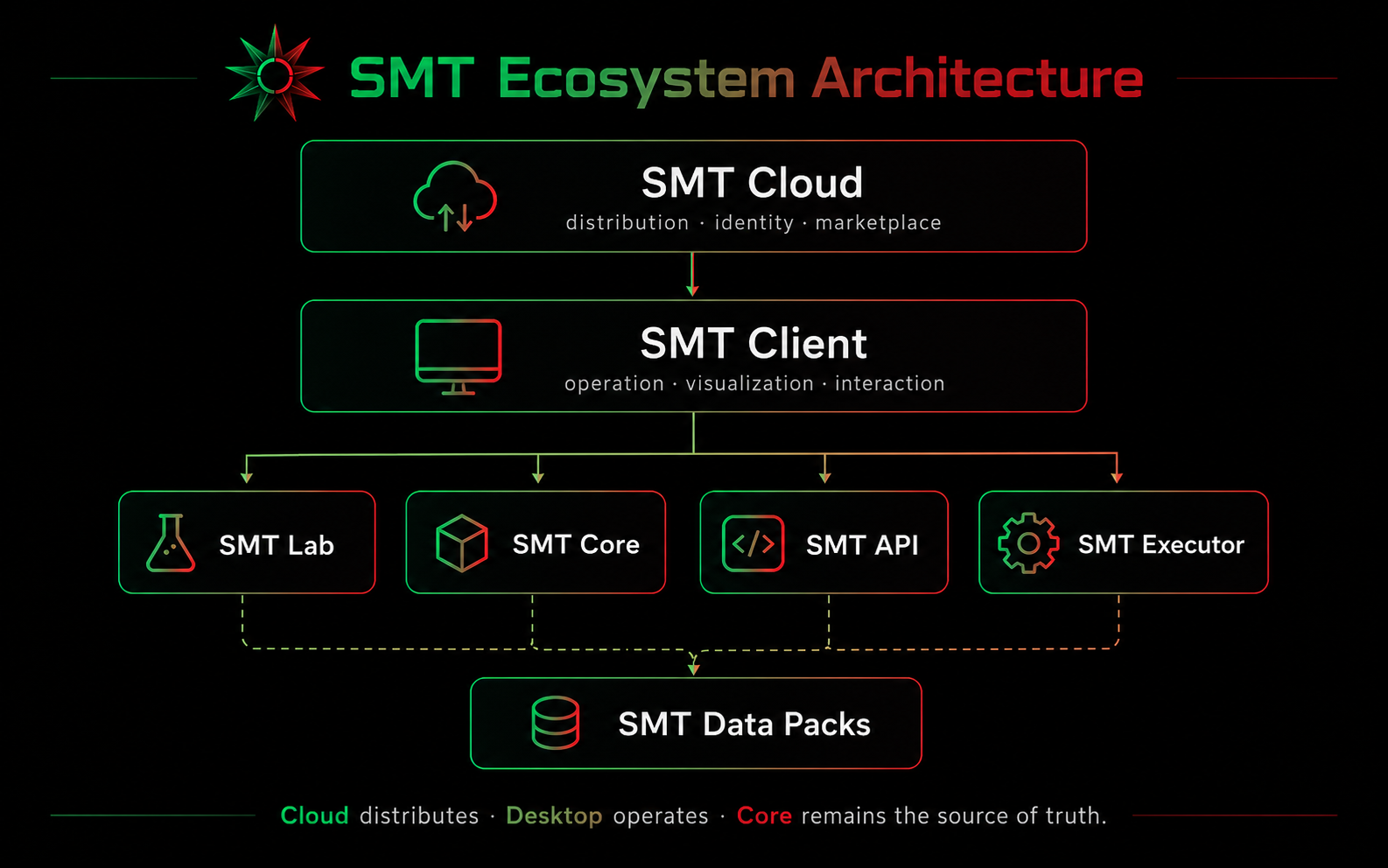
SMT connects Core, Lab, Data Packs, Client, Executor boundaries and distribution components in one documented engineering platform.
The public edition provides the local research, evidence and simulation path. Other components remain clearly marked as evolving or planned.
Trader value
The current edition proves local research, evidence and Paper/Sandbox. The next track turns that into a daily routine: prepare plans, observe public market data, call the operator with context and register decisions to improve the strategy.
Turn an operational idea into a formalized strategy, parameters and versioned knowledge.
Run replay, generate evidence, compare versions and understand where the idea fails.
Move an approved strategy to Paper/Sandbox without real orders, real capital or hidden risk.
Register the session plan: levels, scenarios, invalidation, validity and human review.
Let SMT watch public read-only market data and identify when an opportunity approaches.
Register decisions, acceptances, rejections and outcomes to feed the next strategy version.
Ecosystem
This page presents the ecosystem view without mixing what is implemented with what is evolving or planned.
Local decision and signal engine for safe research and simulation.
Environment to structure ideas, test hypotheses and generate evidence.
Local knowledge packages, examples, reports and study material.
CLI, local interface and future daily experience for the operator.
Future real-execution layer, always isolated by review and controls.
Distribution, licenses, downloads and catalog without operating user capital.
Demonstrable flow
An operational idea becomes structured knowledge.
The platform evaluates conditions and records simulated intent.
Behavior is exercised without real orders.
The operator receives a human-readable view of the result.
The strategy continues, pauses or returns to investigation.
Any move toward execution requires additional gates.
Commercial model
The first public edition should let users experience the method, validate the value and understand the platform. Paid layers should fund deeper, operational and professional capabilities.
For learning SMT, testing the flow and understanding the method without operating real money.
For turning research into an assisted daily monitoring and decision routine.
For users who want to scale research, compare strategies and distribute knowledge.
No layer promises profit. Any use involving real financial risk remains the sole responsibility of the user.
Mission-based engineering
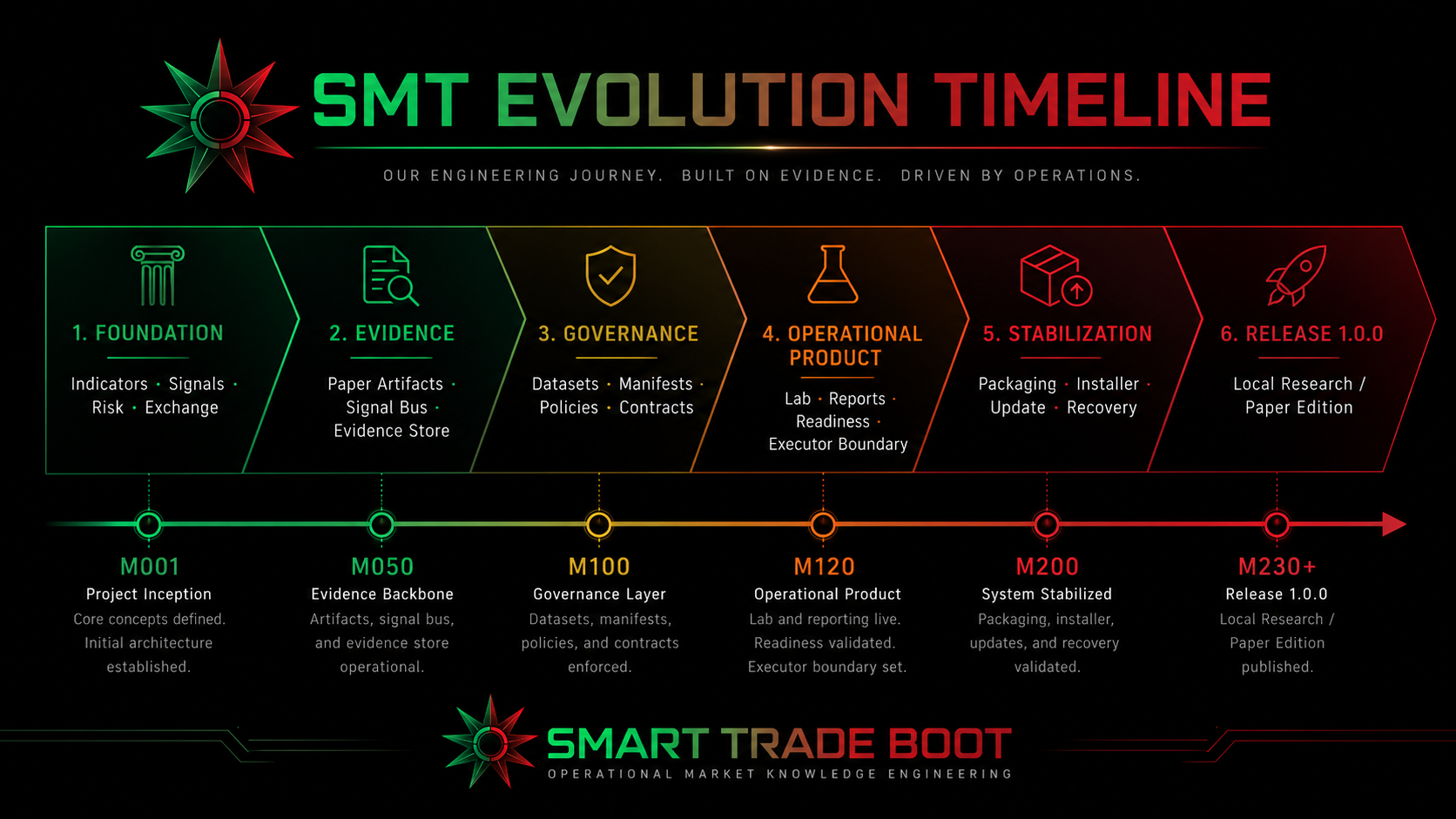
SMT development is organized in eras and missions. Each mission defines boundaries, delivers verifiable artifacts and closes with explicit validation criteria.
Investigate the problem, constraints, risks and expected behavior.
Define contracts, components, responsibilities and boundaries.
Turn design into code, scripts, documentation and artifacts.
Test behavior, regression, integration and failure scenarios.
Package, install, update, preserve data and prepare operation.
Traceability
Case study
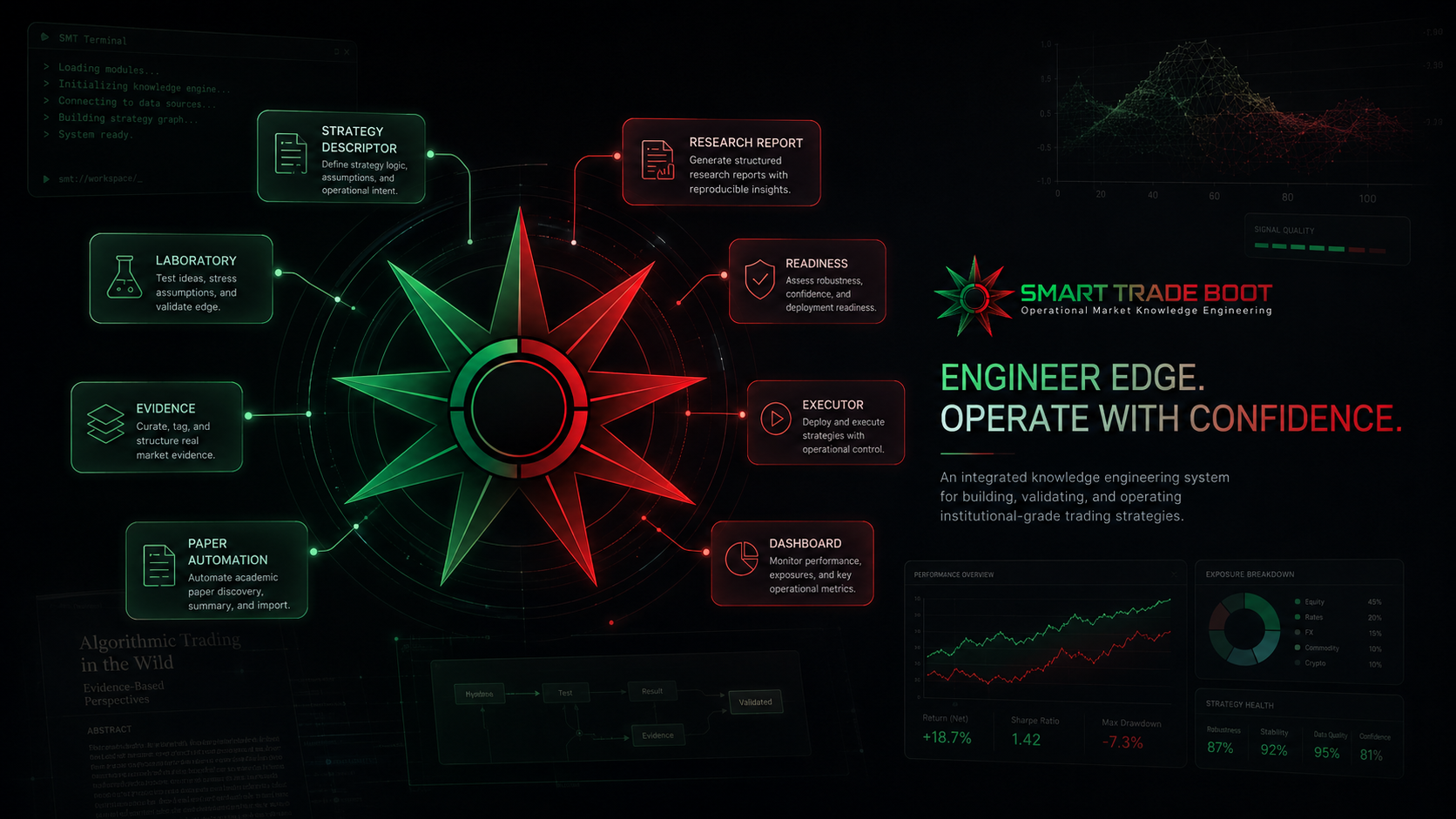
SMT connects laboratory knowledge, signals, evidence and execution without losing traceability. An approved strategy advances to Paper, produces artifacts, generates a report, passes readiness and crosses a Sandbox boundary without touching real capital.
Evidence gallery
Public documents
Possible applications
Organize hypotheses, parameters, replays, evidence and comparisons.
Turn manual processes into traceable pipelines.
Create dashboards, automations, integrations and analytical tools.
Use the public architecture and workflow as technical study material.
Author
Built by Vinicius Sanches, an independent software developer focused on software engineering, automation, data and systems for traceable operations.
He builds software, automation and data pipelines, including the public SMT research environment and its technical documentation.